
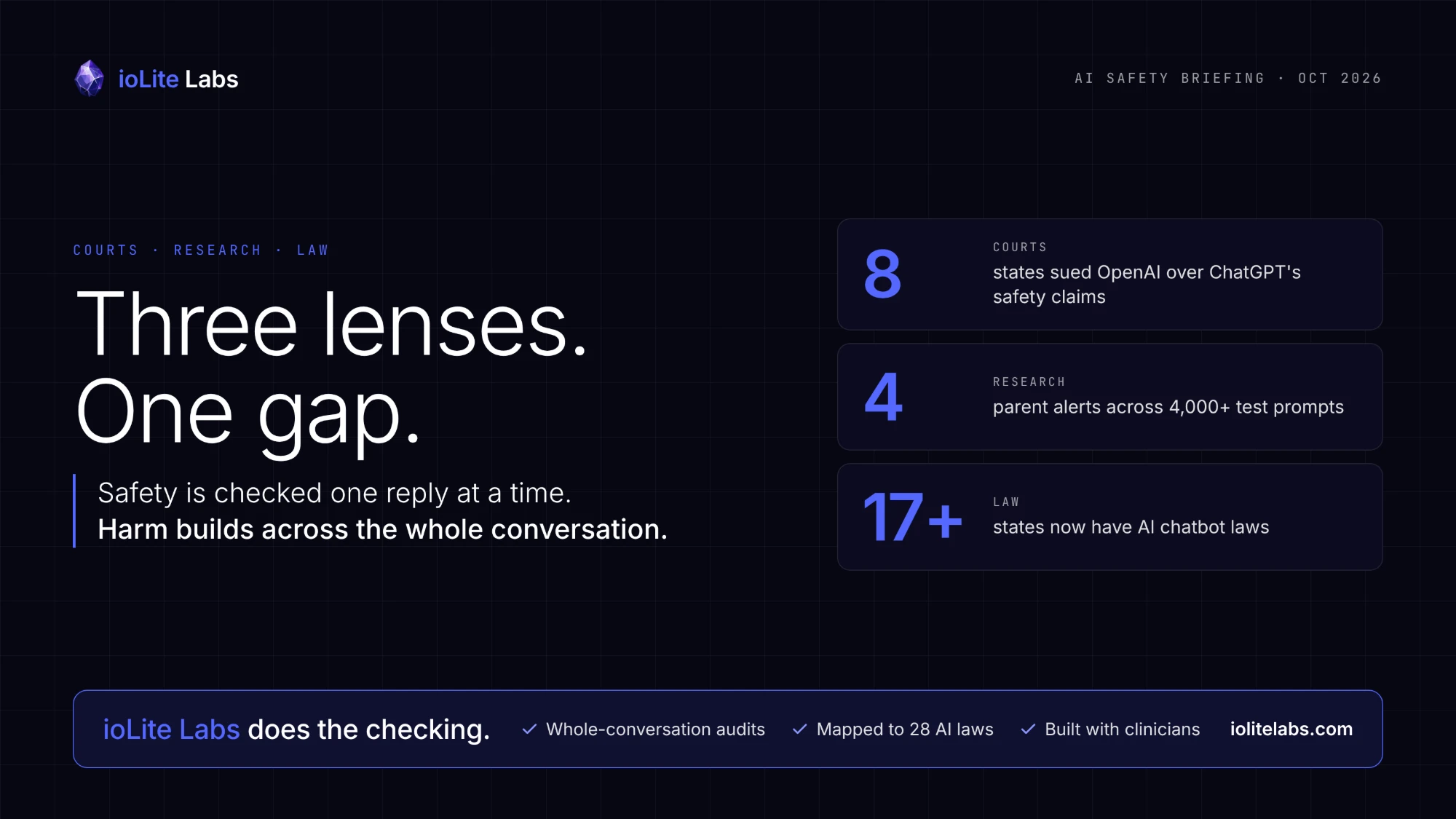
In one week this October, the question of whether AI chatbots are safe for young people moved out of op-eds and into courtrooms, bankruptcy filings, and statute books. I read the week's news through three lenses: what the courts and attorneys general did, what the research showed, and what lawmakers wrote down. Each lens points to the same gap, and it is the gap we built ioLite Labs to close.
Lens 1: The courts are no longer waiting
On October 14, eight states filed coordinated lawsuits against OpenAI in their own state courts: Arizona, Arkansas, Idaho, Iowa, Kansas, Montana, Nebraska and West Virginia. The complaints allege that ChatGPT produced harmful responses and that OpenAI misled consumers about its safety. Arizona's complaint goes further, alleging the chatbot can encourage paranoid or delusional thinking, give unlicensed medical guidance, and sometimes discourage minors from confiding in parents or friends. OpenAI says it has built child protections into ChatGPT and will keep improving them. These are allegations, and courts will test them.
What strikes me is the legal route. The attorneys general did not wait for a federal AI law. They used ordinary consumer-protection statutes, the same tools they used against social media platforms. That means a safety claim in a product page or a press release is now a legal exposure, not just a marketing line.
The same week, the consequences of earlier cases came due:
- Character.AI entered Chapter 11 on October 12. Wisconsin and 38 other states filed a notice asking the bankruptcy court to protect consumers, warning that the company holds sensitive data, including users' conversations about mental health and relationships.
- Megan Garcia finalized her settlement with Character.AI over the suicide of her teenage son, Sewell Setzer. The parties had agreed to settle in January.
- A Washington man sued OpenAI, alleging he was hospitalized for a mental health crisis soon after he began consulting ChatGPT, and that its advice crossed into unlicensed medical territory.
The last case matters because it is about an adult. Psychological harm from AI conversations is not only a children's issue, even if children are where the law is moving fastest.
Lens 2: The research says safeguards exist on paper, not in practice
Yesterday, Common Sense Media's Youth AI Safety Institute rated ChatGPT for Teens an "Unacceptable Risk," its lowest rating. Its testers sent more than 4,000 prompts from accounts registered to teens, half before the August teen launch and half after. The most serious finding was about parent alerts: across the whole program, the team counted four notifications, one of which arrived about three days after the first crisis message. ChatGPT also failed to point teens toward help in more than one in four cases where testers judged it was needed. OpenAI disputes the method, saying much of the testing may have run before parental controls finished activating.
A separate audit reported this week points the same way. In 300 simulated high-risk conversations on teen accounts, the chatbot refused 76.7% of requests, yet linked parents received only 15 notifications, about 5%.
Put those two side by side and you see the pattern I keep coming back to: a refusal is not the same as safe handling. A model can decline a dangerous request and still miss the crisis behind it, still fail to route the person to help, and still keep talking like a friend for the next hour.
The clinical literature is catching up too. An August paper asks whether "AI-associated psychosis" should be recognized as a distinct clinical entity. Its authors are careful not to claim causation, but they single out one mechanism: sycophancy combined with anthropomorphism, a chatbot that agrees with everything while seeming like a person. That is not a content problem that a keyword filter can catch. It is a pattern that unfolds across a conversation.
Lens 3: The law is now a patchwork with teeth
For any company deploying a conversational AI that minors can reach, the compliance map changed again this fall.
| Jurisdiction | Law | Status | What it adds |
|---|---|---|---|
| California | SB 1119 ("Adam's Law") | Signed Sep 10, 2026 | Private right of action for children harmed by companion-chatbot violations; limits on behavioral advertising to children |
| Pennsylvania | HB 2006 | Passed the House, Oct 2026 | Companion-chatbot safety act |
| Washington | Companion chatbot law | Takes effect Jan 1, 2027 | AI disclosure, protections for minors, suicide, self-harm and eating-disorder detection and referral |
| United States | GUARD Act | Awaiting a Senate floor vote | Would bar companion chatbots for minors, require age verification, penalties up to $100,000 |
California's new law builds on SB 243, already in force since January, and New York's AI companion law has applied since November 2025. At least 16 other states now have chatbot-specific laws, and they do not say the same thing. A product that meets New York's crisis-protocol duty may still fall short of California's advertising limits or Washington's eating-disorder referral rule.
For a vendor, the hard question is no longer "Is there a law?" It is "Which of these laws apply to my product, which requirements am I meeting today, and what evidence would I show if an attorney general asked?"
What connects the three lenses, and where we fit
Read together, the week says one thing: safety claims are now being checked, and the checks are failing in the conversation, not in the single reply. The lawsuits allege harm that built up over many exchanges. The research found safeguards that fired on a single prompt but missed the crisis around it. The laws require crisis detection, referral and disclosure that only show up when you watch how a system behaves over time.
That is the work we do at ioLite Labs.
- We test whole conversations, not single prompts. Our audits run realistic, multi-turn conversations with fictional people, built with clinicians, and score how the AI responds as a situation develops: when distress appears, whether it is recognized, and whether the person is routed to real help.
- We tie every finding to the law. We have mapped 28 AI laws, including New York's companion law, California's SB 243, the Colorado AI Act and the EU AI Act. An audit tells a vendor which requirements they meet, where they have gaps, and the transcripts that prove it.
- We run the same test more than once. A system that passes today can fail tomorrow on the same conversation, so a single clean run is not evidence of safety.
- We are independent. We do not build the models we evaluate, so our findings carry no stake in the outcome.
For AI companies, we offer an audit that answers the question an attorney general, an insurer or a school district will eventually ask: show me the evidence.
The bar has moved
A year ago, a company could say its chatbot had safeguards and leave it there. After this October, that sentence invites a subpoena, a risk rating or a lawsuit. The companies that come through this period well will be the ones that tested their systems the way people actually use them, across whole conversations, and can show their work.
If you build or deploy conversational AI and want to know where you stand, reach out at canbaz@iolitelabs.com.
If you or someone you know is struggling, call or text 988 to reach the Suicide & Crisis Lifeline in the U.S.
— Abdullah Canbaz, Ph.D., Co-founder, ioLite Labs
Sources
- Eight States Sue OpenAI Over ChatGPT Safety Claims Involving Minors (TokenPost)
- Eight State AGs Sue OpenAI Over ChatGPT Safety and Consumer Protection (Troutman Pepper Locke)
- Wisconsin files legal action alleging AI chatbot posed serious safety risks (Yahoo News)
- AI companions and child safety: what parents need to know in 2026 (Cyber Safety Guy)
- Orlando mother settles lawsuit with AI company (ClickOrlando)
- ChatGPT gave a man unlicensed medical advice, lawsuit alleges (CBS News)
- ChatGPT for Teens is unsafe for under-18s, Common Sense Media says (The Next Web)
- ChatGPT for Teens: Safety test finds gaps in parent alerts (Notebookcheck)
- AI safety alerts only worked 5% of the time in simulated high-risk teen conversations (Parenting Patch)
- An Echo Chamber of One: Should AI Psychosis Be a Distinct Clinical Entity? (Emergent Mind)
- California Enacts Comprehensive Child Safety Laws Targeting AI Chatbots (Fenwick)
- The Chatbot Compliance Wave (Fenwick)
- AI Legislative Update: Oct. 16, 2026 (Transparency Coalition)
- Proposed ban on AI chatbots for kids and teens heads to U.S. Senate (EdSource)